
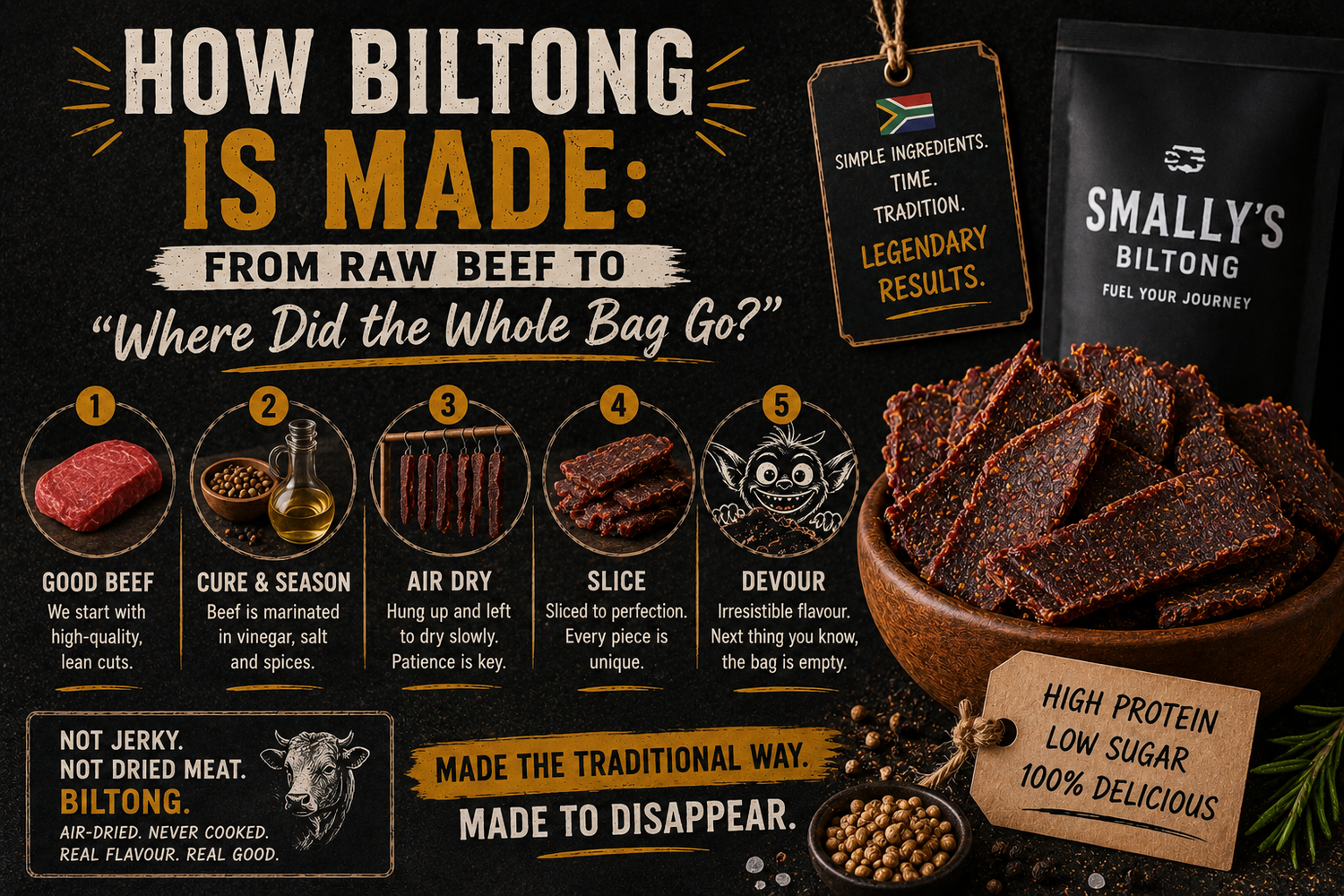
There’s a moment that happens with good biltong. You open the bag planning to “just have a few pieces,” fully believing you’re a person with restraint and self-control. Then somehow, and honestly quite aggressively, you look down five minutes later and realise there’s about three crumbs left and absolutely no memory of eating the rest.
That’s the thing about proper biltong. It disappears, but before it becomes the snack you accidentally demolish while answering emails or pretending to watch a film, there’s actually quite a lot that goes into making it properly. Because despite how simple biltong seems, good biltong is all about patience, balance, and not messing with a process that already works perfectly well.
So, here’s how biltong is made, from raw beef all the way through to the point where you’re wondering who finished the bag.
(Spoiler: it was you.)
It Starts With Good Beef
This part matters more than people think. You can’t make great biltong from poor-quality meat and just hope the spices sort things out later. That’s not how this works. Traditional biltong is usually made using lean cuts of beef because lean meat dries better and gives you that perfect balance between tenderness and chew. Too much fat and things can spoil more quickly. Too little and it can end up dry in all the wrong ways. So the first step is choosing the right cut, something with enough texture and flavour to hold up during the drying process. At this stage, it’s just raw beef. Nothing glamorous yet. No magic. Just good ingredients. Which, to be fair, is usually where good food starts.
Then Comes the Curing
This is where biltong starts becoming biltong. The beef is sliced into strips and coated in a mixture of vinegar, salt, and spices. Coriander is the classic flavour backbone, warm, savoury, slightly citrusy, and if you’ve ever had proper South African biltong, that flavour is probably what you remember. The vinegar isn’t there to make things taste sharp or pickled. It helps preserve the meat and tenderise it slightly while adding that subtle tang that makes biltong taste like… well, biltong. Salt does its thing too, helping draw moisture out of the meat and developing flavour as the curing process begins. Then the spices go to work. Pepper. Coriander. Maybe chilli if things are getting exciting. Simple ingredients, but when they come together properly, they create that rich savoury depth that makes you keep reaching back into the bag even after telling yourself you’re done.
The Drying Is Where the Magic Happens
Here’s the biggest difference between biltong and jerky, by the way. Jerky is usually cooked or heat-dried fairly quickly. Biltong is air-dried slowly. That slower process changes everything.
After curing, the beef is hung up and left to dry naturally over several days. Traditionally, this would have happened in cool, ventilated spaces where air could circulate around the meat properly. And this is where patience matters. Because rushing biltong is a terrible idea.
Dry it too fast and it toughens up. Dry it too slowly and things get weird in ways nobody wants. Good biltong needs balance, enough drying to preserve the meat, but not so much that it turns into edible leather. This is also why no two pieces are ever completely identical. Some cuts dry slightly differently. Some stay a touch softer in the centre. Some develop a firmer chew around the edges. That variation is part of the charm. It feels real because it is.
The Texture Debate Gets Very Serious, Very Quickly
Once the drying process is finished, people start forming opinions… Strong opinions.
There are two camps in the world of biltong: The people who like it softer in the middle, with a slightly tender centre and a richer texture. And the people who want it drier, firmer, and chewier. Neither side is wrong, but both sides will absolutely act like they are. Good biltong sits somewhere in the sweet spot, enough chew to feel satisfying, enough tenderness to keep you coming back for another piece. If you’ve ever had biltong so dry it felt like chewing through an old shoe sole, someone’s messed up along the way.
Then It Gets Sliced (And Dangerously Snackable)
Once the drying is finished, the biltong is sliced into pieces. And this is usually the point where things start disappearing. Because fresh biltong smells incredible. Rich, savoury, slightly spiced, the kind of smell that instantly makes people appear in kitchens asking, “What’s that?” Thin slices, thick slices, chunks, sticks — everyone has a preference. Some people like softer fatty pieces. Others want lean strips with maximum chew. Again, this becomes weirdly personal. But however it’s sliced, this is the stage where biltong officially stops being “dried beef” and starts becoming a problem for your self-control.
Why Simplicity Is the Whole Point
One of the reasons people become slightly obsessed with proper biltong is because the process itself is surprisingly simple. There’s no complicated trick to it. No giant list of ingredients nobody can pronounce.
At its core, biltong is:
- Beef
- Vinegar
- Salt
- Spices
- Time
That’s the formula. And honestly, the fact it hasn’t needed reinventing says a lot. Because while plenty of snacks have spent years trying to become healthier, cleaner, or more “natural,” biltong quietly already was.
It’s Been Around Longer Than Most Snack Trends
Biltong wasn’t invented for gym people or low-carb diets. It originally existed because people needed a way to preserve meat during long journeys across Southern Africa. The vinegar and salt helped prevent spoilage. Air drying did the rest. That practicality became tradition, and that tradition became part of everyday life in South Africa. Which is why biltong doesn’t feel like a trend. It feels established. Proven. Proper. The rest of the world is only just catching up.
Why Good Biltong Disappears So Fast
Here’s the real secret. It’s not just the flavour. It’s the combination of flavour, texture, and satisfaction all happening at once. Biltong fills you up in a way crisps don’t. It tastes indulgent without being overloaded with sugar. And because you actually chew it properly, you notice what you’re eating. It feels substantial. Which is probably why people start buying “a bag for later” and then mysteriously needing another one the next day.
From Raw Beef to Empty Bag
So, how is biltong made? Carefully. It starts with good beef, simple ingredients, and a slow drying process that lets flavour develop naturally instead of forcing it. No shortcuts. No nonsense. No need to overcomplicate something that already works beautifully. And somewhere between the curing, the drying, and that first proper bite, it transforms from raw beef into the kind of snack people become genuinely protective over. Which explains why every bag eventually ends the same way:
You reaching in for one last piece… and realising it’s gone.