
It's funny to think that every time someone tears open a bag of biltong during a football match, a road trip, or while pretending not to snack at their desk, they're participating in a tradition that stretches back hundreds of years. Because despite its recent explosion in popularity across the UK, biltong is anything but new. In fact, long before protein bars, meal prep containers and supermarket "healthy snack" aisles, people were preserving meat in much the same way they do today. The difference is that back then, nobody was doing it to hit their protein goals. They were doing it because, quite simply, they needed to survive.
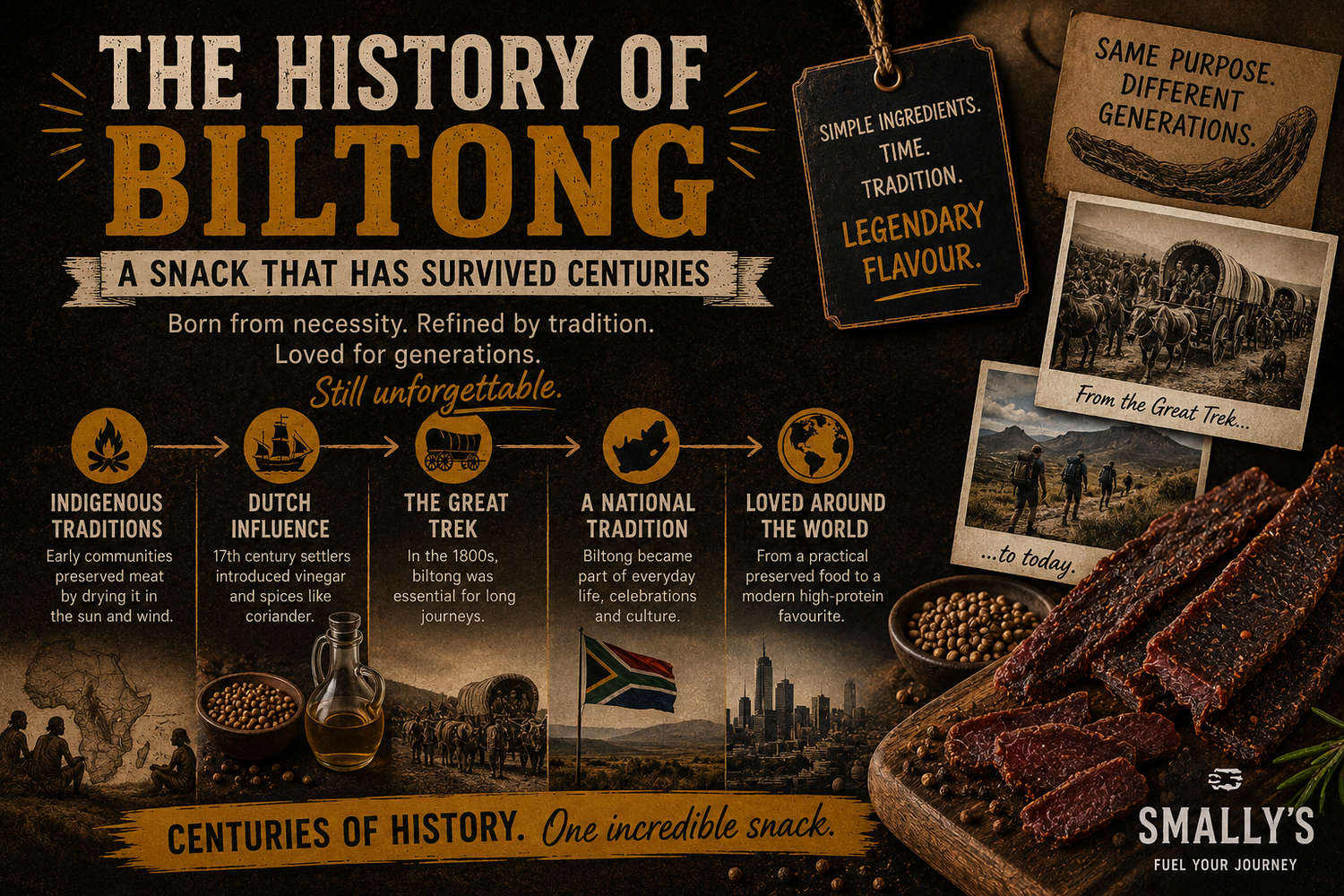
The origins of biltong can be traced back to the indigenous peoples of Southern Africa, who had been preserving meat for centuries before Europeans ever arrived on the continent. Hunting provided an important source of food, but fresh meat has one rather inconvenient flaw - it doesn't stay fresh for very long, particularly in a warm climate. Without refrigeration, communities had to find practical ways of ensuring valuable food supplies didn't go to waste. Drying meat proved to be an incredibly effective solution. Strips of game meat were salted and hung to dry in the warm air, dramatically extending their lifespan and making them easier to transport over long distances. It wasn't glamorous and it certainly wasn't intended to create a beloved national snack, but it worked.
As history often shows, however, some of the world's best foods have humble beginnings.
When Dutch settlers arrived at the Cape during the seventeenth century, they brought with them their own traditions of curing and preserving meat. They also brought ingredients and techniques that would eventually shape what we now recognise as biltong. Vinegar became an important part of the process, helping preserve and tenderise the meat, while spices such as black pepper and coriander seeds were introduced to enhance flavour.
It was during this period that the foundations of modern biltong truly began to form.
Even the name itself reflects these Dutch roots. The word "biltong" is believed to derive from the Dutch words bil, meaning rump or buttock, and tong, meaning strip or tongue. In essence, it translates rather simply into "strips of meat". Not the most exciting name in culinary history perhaps, but then nobody at the time was particularly concerned about branding opportunities.
The true significance of biltong emerged during the Great Trek of the 1830s. As thousands of Dutch-speaking settlers, known as Voortrekkers, travelled inland in search of new opportunities, food preservation suddenly became more important than ever. These journeys were long, arduous and often dangerous. Carrying fresh food simply wasn't practical, and reliable sources of nutrition could not always be guaranteed.
Biltong proved to be the perfect travelling companion.
It was lightweight, rich in nutrients, easy to store and capable of lasting for extended periods without spoiling. It provided an invaluable source of protein during journeys that could take weeks or even months. In many respects, biltong became the original convenience food - although admittedly with considerably more history and significantly less plastic packaging.
Over time, what had started as a practical necessity slowly became something far more meaningful. As communities settled and life became more established, biltong moved from being a survival food to becoming an integral part of South African culture. Families developed their own recipes, each convinced theirs was the correct one. Some preferred more coriander, others favoured extra pepper. Debates emerged over texture, with some insisting biltong should remain soft and tender in the centre while others argued it should be dried until it offered a proper chew.
If this all sounds familiar, it's because these debates are still taking place today.
Like many traditional foods, biltong became deeply intertwined with memory and identity. It became associated with family gatherings, sporting events, long drives and celebrations. For many South Africans, the smell of freshly sliced biltong instantly evokes feelings of home and nostalgia.
And for a remarkably long time, it remained something of a well-kept secret. Outside South Africa, few people had heard of biltong. Those who had usually discovered it through South African friends or specialist shops catering to expat communities. Meanwhile, the rest of the world carried on blissfully unaware that one of the greatest snacks ever created had been quietly existing for centuries. Then something rather unexpected happened.
Modern eating habits finally caught up with biltong. As people became increasingly interested in high-protein foods, simpler ingredients and less processed snacks, biltong suddenly found itself perfectly positioned. What had once been considered a niche product now appeared remarkably modern. Which is slightly amusing when you think about it. While food companies scrambled to develop the next healthy snack trend, biltong simply carried on being what it had always been. Beef. Vinegar. Salt. Spices. Time. No reinvention required.
Today, biltong has found a devoted audience far beyond South Africa. It has become a favourite among gym-goers, food lovers and anyone who simply wants a snack that feels a little more substantial than crisps and a little less artificial than many modern alternatives.
Yet despite its growing popularity, very little about the process itself has changed.
Good biltong still relies on patience. It still depends upon quality ingredients and time-honoured methods. It still carries with it centuries of history and tradition.
Perhaps that's why it has endured for so long. Because unlike many food trends, biltong has never needed to chase relevance. It has survived because it works. Because it tastes good. Because generation after generation has discovered exactly the same thing:
Properly made biltong is incredibly difficult to stop eating.
The only real difference today is that instead of helping travellers survive long journeys across Southern Africa, it now faces a rather different challenge.
Surviving longer than twenty minutes once the bag has been opened.